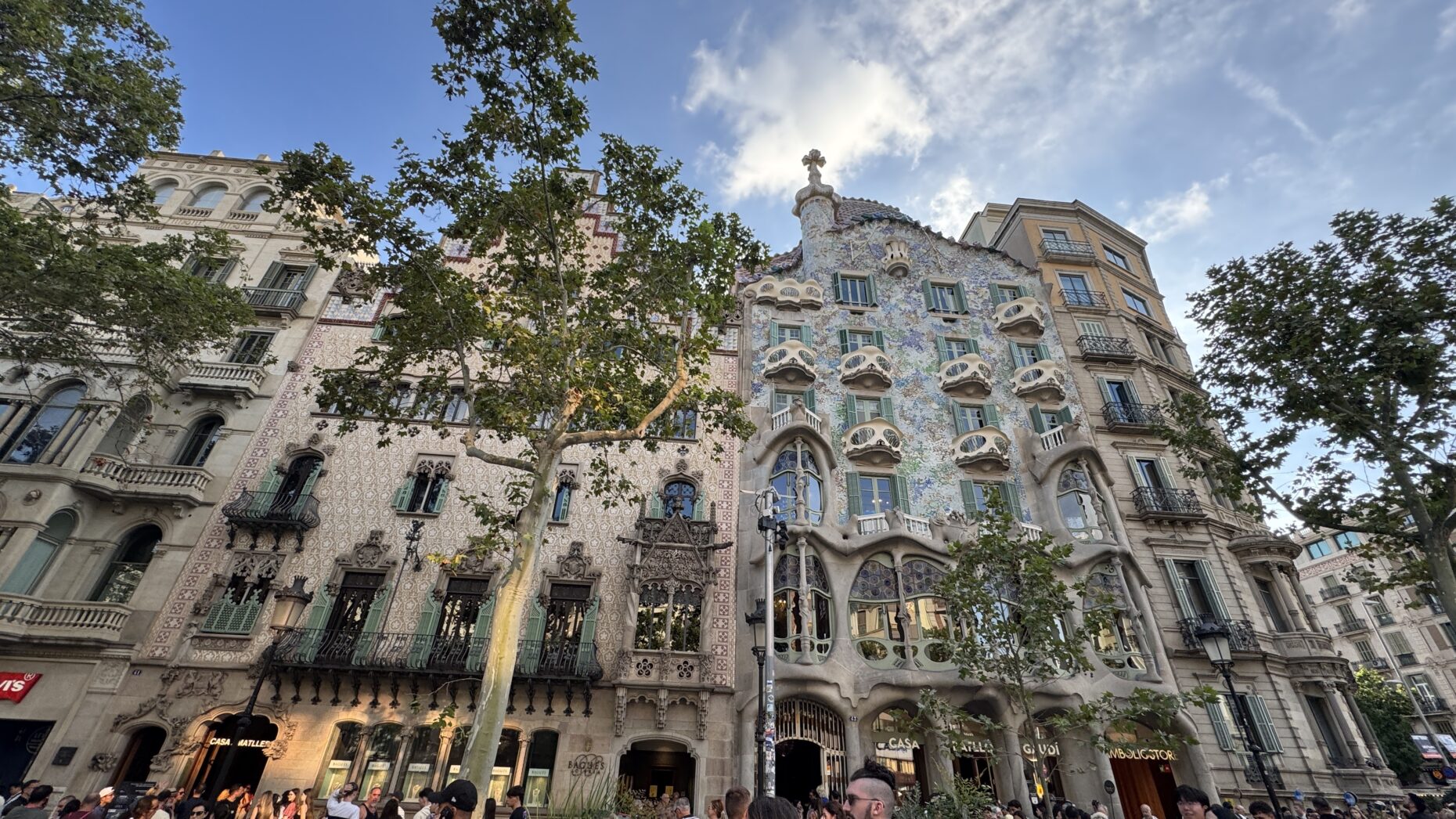
Barcelona gave me a jolt of creative electricity last month. Walking through Casa Batlló—Antoni Gaudí’s 1904 residential masterpiece in the heart of the city—I felt what happens when architecture, engineering, light, craft, and nature move in the same direction. It’s a house, yes, but it’s also a living system where every surface participates in comfort and delight.
The building was originally a conventional apartment block that Gaudí completely reimagined for the Batlló family. What he created defies easy description: undulating stone facades that look like waves or bones, colorful mosaic work that shimmers in sunlight, organic curves that eliminate straight lines entirely. But beyond the visual spectacle, what struck me most was how thoughtfully every element serves both beauty and daily comfort.
Watching my two-year-old son Benjamin gasp in wonder at the building’s immersive spaces crystallized something I’ve always believed: the principles that make extraordinary spaces work apply equally to the homes we create every day.
For homeowners and design professionals, the takeaway is practical: your home can be more than walls and finishes. It can breathe better, sound calmer, age gracefully, and guide daily life with ease.
Below are ten lessons I’ve been thinking about since my return—applicable at any scale, from a weekend refresh to a full transformation.
Lesson 1: Building Systems Should Be Harmonious with the Architecture
Gaudí’s genius went beyond aesthetics. At a time before air conditioning existed, he designed Casa Batlló with a sophisticated natural ventilation system integrated seamlessly into the building’s beauty. A central light well runs through the core of the building, lined with blue ceramic tiles that shift from deep azure at the top to pale sky blue at the bottom, creating an underwater effect while pulling air through the entire structure.
What appears to be purely decorative ironwork is actually a network of ventilation grills. Air flows through ornate registers so beautiful you’d never guess they’re functional. Windows vary in size from floor to floor—larger at the bottom where less natural light reaches, smaller at the top—balancing both light distribution and air circulation.
The principle: HVAC doesn’t have to be an ugly necessity hidden behind closet doors or tacked onto ceilings as an afterthought. When architects, engineers, and contractors collaborate early, we create homes designed for both beauty and performance.
Try this at home: Pair low and high operable windows to create natural air flow through the stack effect. Add a vented skylight or stairwell vent to pull warm air up and out. Use interior shutters or screens for sun control rather than blocking views entirely. Install ceiling fans that reverse seasonally—counterclockwise in summer to create breeze, clockwise in winter to push warm air down. Program a “night purge” routine to flush accumulated heat after sunset before the AC needs to kick on.
Lesson 2: Transitions Shape Experience
One of the most memorable moments at Casa Batlló happens between spaces. Contemporary architect Kengo Kuma designed a dramatic staircase installation that connects the main residence to the basement level where modern art installations are housed. The stairway itself becomes a sculpture—thousands of thin vertical strips create a rippling, immersive environment as you descend.
This magnificent transition illustrates the often underutilized power of in-between spaces. Kuma’s contemporary design doesn’t compete with Gaudí’s 1904 architecture—instead, it creates a moment that prepares you emotionally for what comes next, shifting you from observer to participant. You’re not just moving between floors; you’re experiencing a threshold.
The principle: Most residential design focuses on rooms themselves—the kitchen, the primary bedroom, the living room. But the journey between spaces often gets overlooked. Yet this is where experience is truly shaped: the progression from street to entry, from public areas to private retreats, from active spaces to restful ones.
Try this at home: Be intentional about transitions. How does the entry sequence prepare someone to come home? Consider lighting that gradually shifts from bright exterior to softer interior. What does the hallway between kitchen and bedrooms signal? A material change from hard flooring to softer carpet, a gallery wall that personalizes the journey, or simply a change in paint color can mark the shift from communal to private space. Where do ceiling heights shift, and why? A compressed entry that opens to a taller living space creates drama and relief. These subtle moments—a window placement that frames a view as you turn a corner, a slight level adjustment that signals a zone change—guide people emotionally through their homes. Realtors instinctively understand this: which room you enter first matters. Homeowners feel it when the flow just works, even if they can’t articulate why.
Lesson 3: Technology Should Reveal, Not Replace
The finale of Casa Batlló’s premium tour is “Gaudí Dreams,” an installation housed in what they call the Gaudí Cube—a completely mirrored room where walls, floor, and ceiling reflect infinitely in all directions. New media artist Refik Anadol created an AI-generated video that’s projected onto every surface, surrounding you 360 degrees with swirling, organic patterns that reinterpret Gaudí’s signature forms through machine learning algorithms.
Standing in that room with my family, I watched patterns that felt simultaneously futuristic and faithful to Gaudí’s century-old spirit. The technology didn’t replace or overwhelm the architecture—it revealed new dimensions within it, translating Gaudí’s hand-drawn organic logic into digital movement. My son reached toward the projections as if he could touch them, completely immersed in the experience.
The principle: Technology shouldn’t announce itself or become the star of the show. It should quietly enhance daily life and deepen your experience of the space itself.
Try this at home: Consider lighting systems that adjust color temperature and intensity throughout the day—cooler, brighter light in the morning to support alertness, warmer tones in the evening to support circadian rhythms and relaxation. Integrated sound systems that make spaces feel energizing or contemplative without visible speakers cluttering walls. Smart home systems that learn your patterns and anticipate needs—lights that turn on as you approach, thermostats that adjust before you feel uncomfortable—without requiring constant management through apps. The best residential technology disappears entirely, leaving only the feeling it produces.
Lesson 4: Daylight Without Glare
Throughout Casa Batlló, natural light flows abundantly but never harshly. Gaudí treated light as a gradient rather than a spotlight, using the building’s central light well to distribute illumination evenly through all floors. He varied window sizes strategically—smaller openings where light is abundant, larger ones where it needs to reach deeper—and used colored glass to filter and soften incoming sunlight.
The principle: Quality of light matters more than quantity. A room flooded with harsh glare is less comfortable than one with softer, well-distributed natural light.
Try this at home: If you’re adding skylights or clerestories, pair them with diffusers, frosted glass panels, or translucent screens that scatter light rather than focusing it into bright spots. Use architectural light shelves—horizontal surfaces that bounce light off the ceiling—to push daylight deeper into rooms. Paint ceilings in pale, matte finishes that reflect without glare. Place task lighting where you need precision for reading or cooking, and let ambient daylight stay soft and indirect for general comfort.
Lesson 5: Rooms That Sound Calm
Casa Batlló feels remarkably quiet despite being located on a busy Barcelona avenue. Part of this is Gaudí’s use of organic, curved forms—there are virtually no hard right angles or flat planes to bounce sound harshly. The layered textures throughout—plaster moldings, ceramic tiles, carved woodwork—help scatter and absorb sound waves naturally.
The principle: Acoustic comfort is spatial comfort. A room can be beautiful but uncomfortable if sound echoes harshly or carries between spaces without privacy.
Try this at home: Add area rugs with quality natural fiber pads underneath—they absorb impact sound and soften acoustics significantly. Install lined drapery rather than bare blinds. Fill walls with bookshelves (books are excellent sound absorbers). Consider textured plaster finishes or discrete acoustic panels in spots where echo is problematic, like tall ceilings or hard-surfaced open plans. If you’re renovating, round sharp drywall corners where walls meet ceilings—even a subtle curve softens sound reflections. In open floor plans, use upholstered seating and consider ceiling baffles or clouds to tame echo without closing off the space visually.
Lesson 6: Materials That Age Beautifully
Walking through a 120-year-old building that still feels vibrant teaches you about material longevity. Gaudí chose honest, durable materials—stone, ceramic, solid wood, wrought iron—that develop character over time rather than simply wearing out. The mosaic work on the facade has gained a gentle patina. The carved stone balconies have weathered gracefully. Nothing looks tired or dated; it looks layered with time.
The principle: Durable beauty outlasts trends. Materials that age well actually improve with use, developing warmth and character rather than requiring replacement every decade.
Try this at home: Choose limewash or mineral paint that develops subtle variation rather than plastic-based paints that peel. Consider terrazzo (either traditional or contemporary) that can be refinished rather than replaced. Use oiled wood instead of polyurethane—it warms with age and can be easily touched up with more oil. Specify zellige or hand-glazed tile with natural variation rather than perfect machine-made versions. Favor solid wood that can be refinished over veneer, and metal that can patina rather than coated finishes that chip. For high-use family areas, specify removable, washable slipcovers on seating. Keep a small maintenance kit—wood oil, touch-up paint, grout cleaner—for easy care rather than deferred replacement.
Lesson 7: Storage That Feels Like Architecture
Throughout Casa Batlló, built-in elements feel integral to the rooms rather than added on. Benches, shelving niches, and closets are carved into the architecture itself, often following the building’s organic curves. They calm the visual field rather than cluttering it, and they support daily habits seamlessly.
The principle: Storage should disappear into the architecture, reading as part of the walls and structure rather than as furniture shoved into corners.
Try this at home: Look for opportunities to build in rather than add on. Window seats with lift-up lids provide seating, storage, and a cozy reading nook in one gesture. Under-stair space can become drawers or a coat closet rather than dead space. Create niche shelving sized to real objects—your actual books, your daughter’s trophy collection, your coffee station—so items feel displayed rather than stuffed in. Design a mail drop near the entry with concealed device charging so daily clutter has a home. When adding built-ins, align door reveals and panel lines with existing wall planes so storage reads as architecture, integrated from the beginning.
Lesson 8: Biophilic Design in Small Doses
Casa Batlló’s organic forms constantly reference nature—bone-like columns, scale-like roof tiles, shell-inspired curves, underwater color gradients. Gaudí understood that bringing nature’s patterns and materials into built space creates an instinctive comfort, even in a dense urban setting.
The principle: You don’t need a greenhouse or floor-to-ceiling windows to benefit from biophilic design. Tiny, consistent cues of nature improve mood, reduce stress, and enhance focus.
Try this at home: Add a dedicated plant ledge at a sunny window rather than scattering pots randomly. Install a wood handrail that warms to the touch rather than cold metal. Use a stone threshold at the entry that signals the transition from outside to in. Frame a specific view—even a small one of a single tree or patch of sky—with a thoughtfully placed casement window that catches breeze and foliage. Incorporate natural patterns in tile, textiles, or wallpaper that echo organic forms without being literal. The cumulative effect of these small gestures is significant.
Lesson 9: Rooms That Adapt as Life Changes
While Casa Batlló was designed for a specific family’s needs in 1904, its generous proportions and thoughtful spatial planning have allowed it to adapt over 120 years—from private residence to offices to the cultural landmark and museum it is today. The rooms work because the underlying proportions and flow are sound.
The principle: Life changes constantly—kids grow, careers shift, aging parents move in, hobbies evolve. Rooms should pivot gracefully rather than requiring major renovation every time your needs change.
Try this at home: Use pocket doors or full-height sliding panels to create spaces that can be open or closed depending on need—a home office that becomes a guest room, a playroom that closes off for Zoom calls. Specify ample electrical outlets and a center ceiling junction box in every room so future fixture swaps don’t require opening walls. Design built-ins with conversion in mind—a desk that could become a vanity, a play bench with storage that could later house media equipment or become a bar, bookshelves with adjustable heights. The investment in flexibility pays back every time life shifts without requiring construction.
Lesson 10: Outdoor Spaces as Extensions of Home
Casa Batlló’s rooftop terrace is one of its most magical spaces. Gaudí created defined “rooms” outdoors through carefully placed walls, sculptural chimneys, and varied paving. Even though you’re exposed to sky and weather, the space feels sheltered and intentional—not just a leftover area, but a designed destination.
The principle: Defined edges, layered shade, and thoughtful details turn outdoor space into true living area rather than just “the yard.”
Try this at home: Create a sense of ceiling overhead with a pergola, canopy, or even a mature tree that provides dappled shade. Define the “walls” with a low seating wall, hedge, or planted border. You don’t need solid enclosure, just enough edge to create psychological definition. Establish a ground plane with pavers, decking, or gravel distinct from surrounding lawn or plantings. Provide one clear view focus toward a garden feature, a distant vista, or even inward toward a fire feature or fountain. Add warm evening lighting at human scale (not just overhead flood lights). Include weather-tolerant cushions and throws so the space invites actual use, not just looks. You’ve just extended your functional floor plan without adding expensive square footage under roof.
Where to Start
If you’re planning a renovation: Make systems and storage part of the design conversation from day one, not afterthoughts squeezed in after the fun design decisions. Choose one comfort goal, cooler summers, quieter evenings, better natural light, and implement two tactics from the matching lesson above.
If you’re living with your space as-is: Pick one “arrival” upgrade from Lesson 2, a better entry light fixture, a dedicated bench for dropping bags and shoes, a thoughtful hook or shelf for keys and mail, and notice how it changes your daily mood and routine.
If you’re considering a transformation: Casa Batlló reminds us that homes work best when beauty and function move in the same direction, when systems are poetry rather than problems, when every detail serves both practical need and emotional experience. If you’re ready to explore how your home could become a true sanctuary, a space that makes you pause with joy rather than stress, I offer complimentary 30-minute consultations to discuss what’s possible. Schedule directly here.